The Arousal Scale: A Simple Way to Understand Control
Everyone talks about "the edge" or "the point of no return" — but as a tool, it's nearly useless. It's a single, all-or-nothing alarm that goes off at the exact moment it's already too late to do anything about. You don't need a cliff-edge siren. You need a dashboard.
That's what the arousal scale is. By giving your arousal a simple number from 1 to 10, a vague, slippery feeling becomes something you can actually read — and once you can read it, you can act on it early, while you still have choices. It's also a quiet reminder that control was never really about lasting longer through force. It's about noticing arousal sooner and choosing a more deliberate pace.
The trouble with "the edge"
"The edge" encourages binary thinking: you feel not close… and then suddenly you feel too late. There's no runway in between, because you weren't tracking the climb — you were only watching for the cliff.
Real control happens earlier than that. It happens at 5 and 6, when there's still plenty of room to ease off. The arousal scale exists to make those mid-range moments visible.
The scale, 1 to 10
Think of arousal as a dial you can read at a glance:
- 1–3 — Calm. Low, relaxed, plenty of headroom.
- 4–6 — Climbing. Arousal is building. This is the zone where awareness pays off most.
- 7 — Getting close. The smart place to ease off: slow down, pause, or breathe. Acting here is the whole game.
- 8–9 — High and urgent. Possible to pull back, but much harder.
- 10 — The point of no return. By definition, past the point of choice.
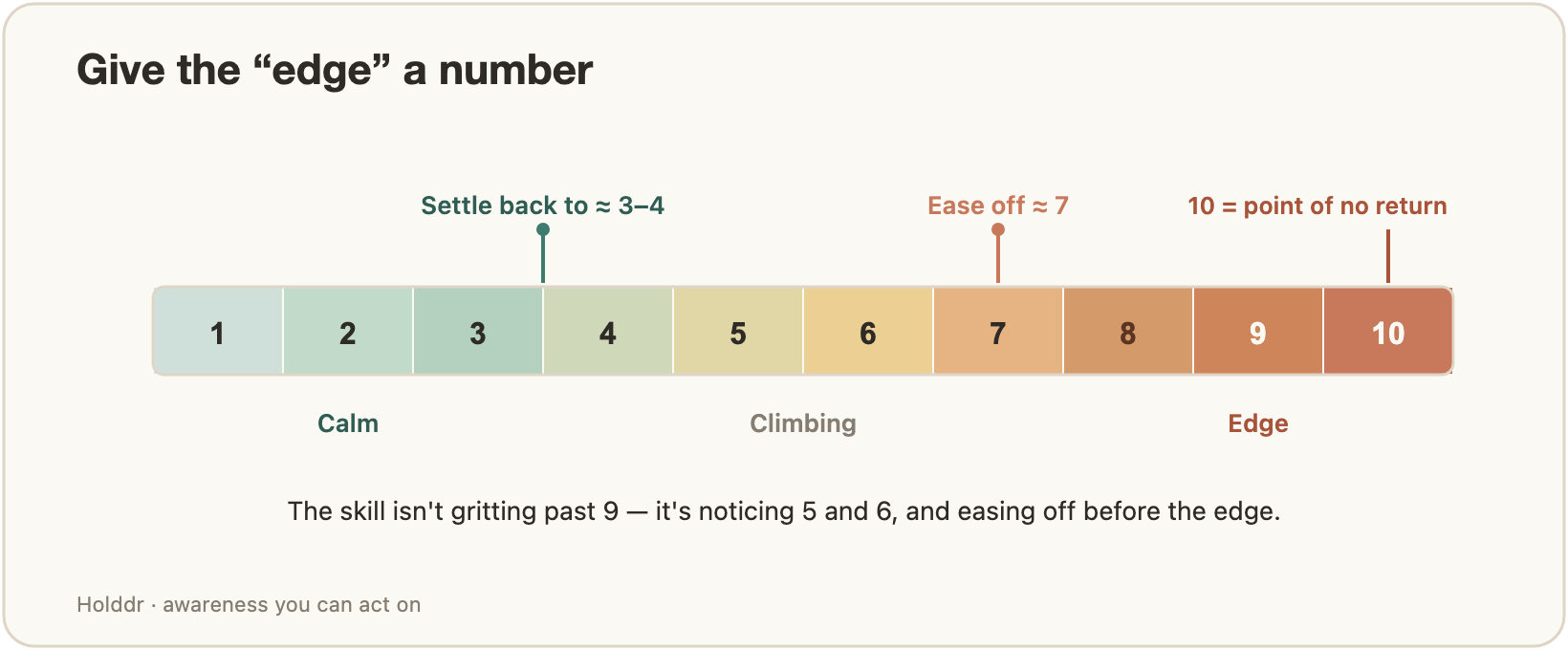
The most common mistake is trying to white-knuckle it at 9. That's too late, and gritting your teeth only adds the pressure that speeds things up. The actual skill is gentler: notice 5 and 6 calmly, ease off around 7, let arousal drift back down to 3 or 4, and then resume. That rise-and-settle rhythm is exactly the stop-start pattern — the scale is just what tells you when to pause.
How to actually use it
Start on your own, with no pressure and no audience:
- As arousal builds, quietly name the number to yourself. "That's a 5… now a 6…"
- When you reach around 7, ease off — slow, pause, or take a few slow breaths.
- Let it settle back toward 3 or 4, then resume.
Here's the quietly powerful part: the act of naming a number is the training. It pulls you out of spectatoring — the anxious self-monitoring — and into calm, accurate observation. You're no longer panicking about an outcome; you're just reading an instrument.
Why a number beats willpower
"Don't finish too fast" is a command your body cheerfully ignores under pressure. "I'm at a 7" is information — and information is something you can act on. That single shift, from fighting an urge to reading a signal, is what turns control from a struggle into a skill.
It also widens what "progress" means. You don't have to wait for the clock to change to know it's working: noticing your arousal earlier and more accurately is progress in itself, and it usually shows up first — often well before timing does.
Where it gets precise
The catch is that "7" isn't identical for everyone, and reading your own scale accurately takes reps to develop. That's where guided practice helps. Inside Holddr, you calibrate your scale, the stop-start practice is paced around it, and you can see your awareness sharpen over the weeks — until reading the dial becomes second nature rather than something you have to think about.
When it's worth talking to someone
The scale is a safe thing for anyone to practice. As always, though: if the change is recent, if there's pain or new erectile or urinary symptoms, or if erections are also a challenge, those are worth a clinician's input first.
FAQ
What is the arousal scale?
It's a simple 1–10 way of rating how aroused you are in the moment — from calm (1–3), through climbing (4–6), to the edge (8–10). Putting a number on it makes a vague sensation easy to read and act on.
What number should I slow down at?
Many men find it works best to ease off around 7 — comfortably before the 8–10 zone where pulling back gets hard. Your exact number is personal, and you get better at finding it with practice.
Doesn't counting arousal kill the mood?
It tends to do the opposite. It's a quiet internal note, not a calculator, and it replaces anxious panic with calm information. With practice it becomes automatic — you barely notice youre doing it.
How is this different from just "lasting longer"?
Lasting longer is one possible result; the scale builds the underlying skill — earlier awareness, less panic, and a more deliberate pace. Control is broader than the clock.
Learn to read your own dial
Holddr is a private men's wellness app for guided practice around control, confidence, breathing, and arousal awareness. It helps you calibrate your personal arousal scale and practice acting on it — so the "edge" stops being a guess and becomes something you can see coming.
Holddr is a wellness app in the Health & Fitness category. This article is educational and is not medical advice, diagnosis, or treatment. If your concerns are recent, painful, distressing, or come with new erectile or urinary symptoms, please speak with a qualified clinician.
Ready to apply the science?
Join early access to be notified when Holddr launches.