Kegels vs Reverse Kegels: What Men Should Know
If you've read anything about men's sexual wellness, you've almost certainly run into the advice: just do your kegels. It's not wrong — but it's barely half the story, and the missing half is the part that actually trips men up.
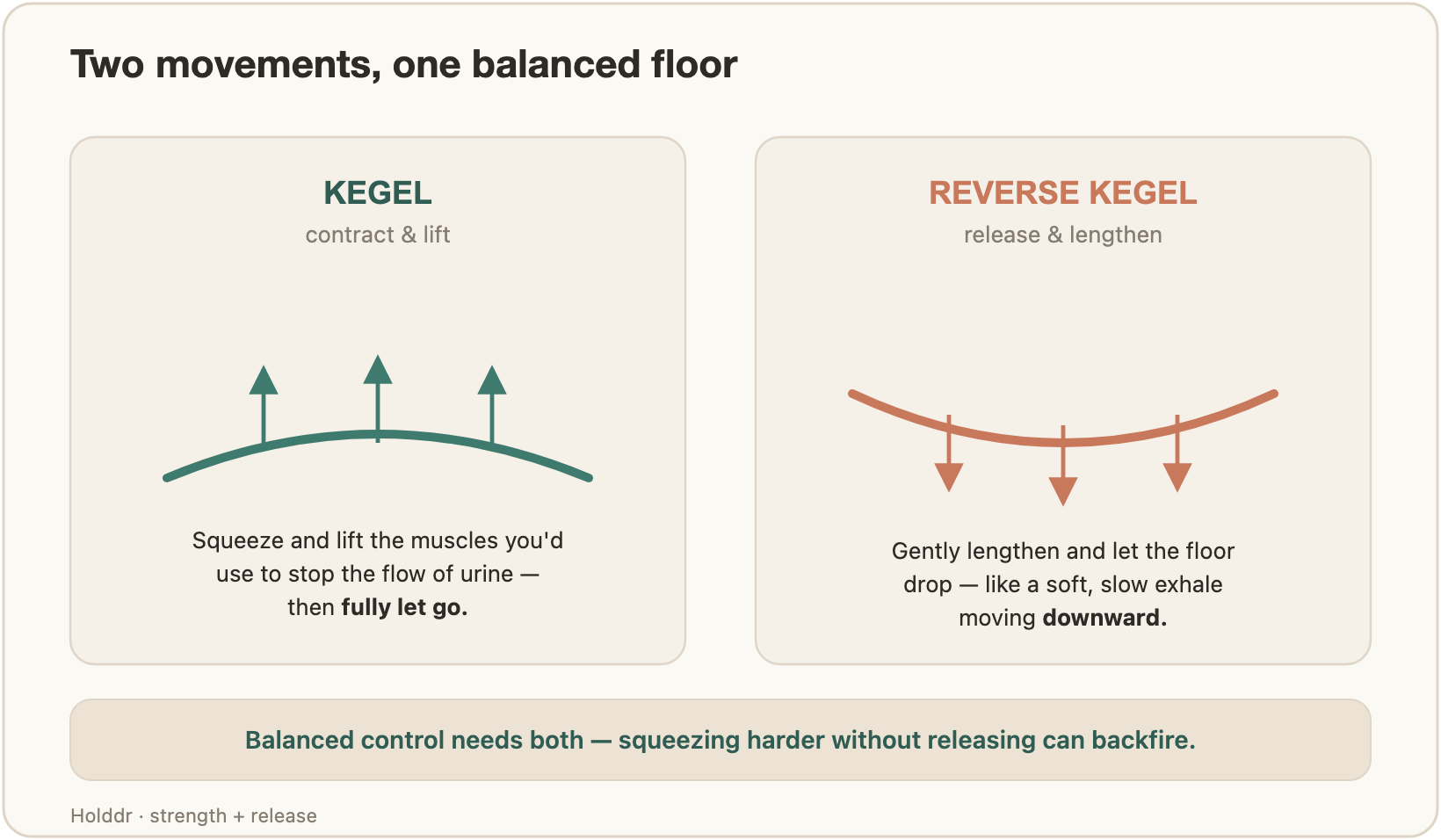
Kegels train your pelvic floor to contract. Reverse kegels train it to release. Real, usable control comes from being able to do both — and from knowing that squeezing harder and more often is not the same as getting better.
A quick, no-jargon tour of the pelvic floor
Your pelvic floor is a sling of muscles at the base of your pelvis — picture a small hammock running front to back. It quietly supports your bladder and bowel, and it plays a part in erections and ejaculation. You already use these muscles every day: they're the ones you'd tighten to stop the flow of urine, or to hold in gas.
Here's the key idea most advice skips: like any muscle group, healthy function isn't only about strength. It's about being able to contract when you want to and fully relax when you don't. A floor that can only clench is not a "strong" floor — it's a stuck one.
Kegels: the squeeze
A kegel is a deliberate contraction — you tighten and lift those muscles, hold for a moment, and then let go.
Pelvic floor training of this kind is associated with improved ejaculatory control in published research, which is genuinely encouraging. One honest caveat, though: much of that research involved supervised rehabilitation — guided by a physiotherapist, sometimes with biofeedback or other clinical tools. That isn't the same thing as doing squeezes on your own from a blog post, so it's best read as promising context, not a personal guarantee.
The single most overlooked part of a kegel is the release at the end. If you only ever practice the tightening, you're training half a movement.
Reverse kegels: the release
A reverse kegel is the opposite motion: gently lengthening and letting the pelvic floor drop and open, rather than pulling it up and in. A useful mental cue is a slow exhale that seems to travel downward, or the gentle sensation right before you'd pass urine or gas — without actually doing either.
Why does this matter so much? Because a lot of men unknowingly carry chronic tension down there, and a floor that's permanently braced can be just as unhelpful as one that's weak. Reverse kegels are how you train the let-go — and they're almost always the missing piece in the "just do kegels" advice.
Why both — and why "more" isn't better
Think of it as a dial you can turn in either direction, on purpose:
- Strength without release leaves you with a clenched, fatigued floor that never fully switches off.
- Release without awareness leaves you with no responsiveness when you'd actually like some.
Control lives in the range between them — the ability to move from tense to relaxed deliberately. This is also why piling on more kegels, harder, can quietly backfire: it can raise your baseline tension and even cause discomfort. With the pelvic floor, more is genuinely not better. Balance is.
A gentle way to begin
Keep this light, brief, and completely pain-free — this is about finding and feeling the movements, not grinding out reps.
- Locate the muscles using the stop-the-urine-flow cue — just once, to find them. (Don't make actually stopping your urine a regular habit; it's only a way to identify the right muscles.)
- Practice a few gentle contractions, each with a full release. Give the release as much attention as the squeeze.
- Try a few slow reverse kegels paired with a long exhale, letting everything soften and lengthen.
- Quality over quantity, every time.
Getting the balance right — how much, how often, when to contract versus release, and how to progress without over-tightening — is exactly the part that's hard to judge alone. Inside Holddr, pelvic floor work is taught as awareness, gentle contraction, and full release, paced safely over the program rather than left to guesswork. (For more on the everyday-tension side of this, see pelvic floor exercises for men: tension, release, and awareness.)
When to see a professional
If you have pain, discomfort, or real difficulty relaxing the pelvic floor, the right person to see is a pelvic floor physiotherapist — that supervised, hands-on guidance is the gold standard, and an app (this one included) is not a substitute for it. The usual signposts apply too: if the change is recent, or if erections are also a challenge, it's worth a clinician's input first.
FAQ
What's the difference between a kegel and a reverse kegel?
A kegel contracts and lifts the pelvic floor; a reverse kegel releases and lengthens it. One is the squeeze, the other is the let-go — and balanced control uses both.
Can doing too many kegels cause problems?
It can. Over-training the contraction without ever practicing release can raise baseline tension and lead to discomfort. More squeezing isn't more progress; balance between tension and release is the goal.
How do I find my pelvic floor muscles?
The simplest cue is to imagine stopping the flow of urine or holding in gas — the muscles that engage are the ones you're after. Use that just to locate them, not as a routine exercise on its own.
Do pelvic floor exercises actually help with control?
They're associated with improved ejaculatory control in published research, though much of that evidence comes from supervised rehabilitation rather than solo practice. Treat it as encouraging, not a guaranteed personal result.
Train the release, not just the squeeze
Holddr is a private men's wellness app for guided practice around control, confidence, breathing, and arousal awareness. Its pelvic floor work is built around the part most advice forgets — awareness, gentle contraction, and full release — paced so you don't over-tighten along the way.
Holddr is a wellness app in the Health & Fitness category. This article is educational and is not medical advice, diagnosis, or treatment. App-based practice is not a substitute for supervised pelvic floor rehabilitation. If you have pain, recent changes, or new erectile or urinary symptoms, please speak with a qualified clinician.
Ready to apply the science?
Join early access to be notified when Holddr launches.