Pelvic Floor Exercises for Men: Tension, Release, and Awareness
Ask the internet about the male pelvic floor and you'll get one answer on repeat: do your kegels. But here's something that catches a lot of men off guard — for many of them, the issue was never a weak pelvic floor. It was a chronically tense one.
Strength is rarely the missing piece. Awareness and the ability to relax almost always are. If kegels and reverse kegels are the two movements, this article is about the thing underneath them: learning to feel what's happening down there, and learning to let it go.
The pelvic floor holds stress — just like your shoulders
You already know that stress shows up in your body. It tightens your shoulders, clenches your jaw, knots your stomach. The pelvic floor is no different — it's one of the quietest places we store tension.
Anxiety, long hours sitting at a desk, bracing through a stressful day, the habit of holding everything in — over time, all of it can leave the pelvic floor quietly switched on most of the day, without you ever noticing.
And this is the crucial reframe: a chronically tight floor is not a strong floor. It's a stuck one. It can't contract well from an already-clenched starting point, and it never fully rests. Piling more squeezing on top of that is like doing bicep curls with an arm that's already cramping.
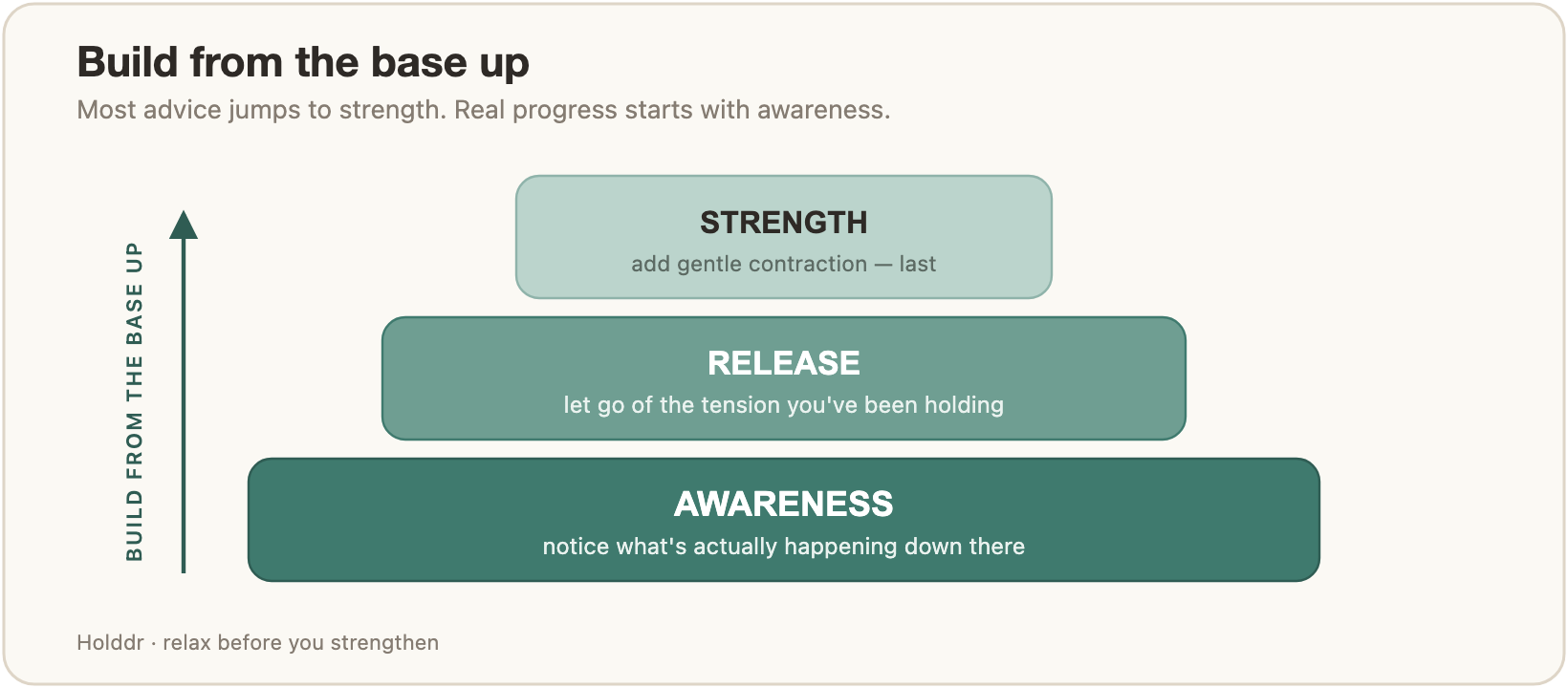
Awareness: the skill underneath everything
You can't release what you can't feel. And the honest truth is that most men have almost no felt sense of this part of the body at rest.
So the first real skill isn't squeezing, and it isn't even releasing — it's noticing. What does my pelvic floor feel like right now? Tense? Neutral? Am I gripping without realizing it? Build that with a few quiet check-ins through the day — while sitting, while stressed, while focused on a screen. Awareness is the master skill: it's what makes release, gentle strengthening, and even arousal awareness possible in the first place.
Release: the underrated half
Once you can feel it, you can let it go. The tools are simple: the gentle reverse-kegel "let-go," paired with a long, slow exhale and a conscious softening of the pelvic floor, belly, and jaw together.
For a great many men, this is where most of the benefit lives. Learning to relax a floor that's been quietly braced for years often matters far more than adding any strength to it.
Strength comes last — and gently
Only once you can reliably feel and release should you add gentle contraction. Loading strength onto a floor you can't sense and can't relax is exactly how people end up tighter, more fatigued, and more uncomfortable than when they started.
So the order matters, and it's the reverse of the usual advice: Awareness → Release → Strength. Start at the base.
The mind and body feed each other
There's a loop here worth naming. A braced body and an anxious mind reinforce one another: tension feeds the alarm state, and the alarm state tightens the body right back. Releasing physical tension can take some of the air out of that loop — and calming the mind can loosen the body. It's why pelvic floor awareness, breathing, and calm all belong in the same practice, not separate boxes.
How Holddr approaches it
Rather than "do 30 kegels," Holddr teaches the pelvic floor as awareness, gentle contraction, and full release — in that order — paced across the program so you build the base before the peak. And a private coach is there for the questions you'd rather not ask out loud. (As always: app-based practice is a supportive habit, not a substitute for hands-on, supervised care.)
When to see a professional
If you have pain, discomfort, or genuine difficulty relaxing the pelvic floor, the right person to see is a pelvic floor physiotherapist — their hands-on assessment is the gold standard, and no app can replace it. And the usual signposts hold: recent changes, or erections that are also a challenge, are worth a clinician's input first.
FAQ
What are the best pelvic floor exercises for men?
Not just kegels. A balanced approach builds awareness first, then practices full release, and only then adds gentle contraction. For many men, the relaxation half is the more important — and more neglected — one.
Can a tight pelvic floor cause problems?
Chronic tension can be unhelpful and uncomfortable, and a permanently braced floor isn't a strong one — it's stuck. Being able to relax is just as important as being able to contract.
How do I relax my pelvic floor?
Start by noticing it through the day, then practice the reverse-kegel "let-go" paired with a long, slow exhale, softening the pelvic floor, belly, and jaw at once. If you struggle to release it at all, a pelvic floor physiotherapist can help directly.
Should men do kegels every day?
Quality beats quantity, and release matters as much as the squeeze — so more is not better. If you're unsure, or you have any symptoms, it's worth getting guidance rather than grinding out daily reps.
Learn to relax before you strengthen
Holddr is a private men's wellness app for guided practice around control, confidence, breathing, and arousal awareness. Its pelvic floor work is built from the base up — awareness, then release, then gentle strength — so you're not just squeezing harder and hoping.
Holddr is a wellness app in the Health & Fitness category. This article is educational and is not medical advice, diagnosis, or treatment. App-based practice is not a substitute for supervised pelvic floor rehabilitation. If you have pain, recent changes, or new erectile or urinary symptoms, please speak with a qualified clinician.
Ready to apply the science?
Join early access to be notified when Holddr launches.