Performance Anxiety and Control: The Feedback Loop
There's a specific kind of dread that can show up before or during intimacy — a quiet voice asking what if it happens too fast again? If you know that voice, you're far from the only one. And here's the uncomfortable irony at the center of it: the fear of finishing quickly can become part of what makes it happen.
That's not a character flaw, and it's not something being broken in you. It's a loop — a predictable cycle that the mind and body fall into together. Once you can see the shape of it, it stops feeling like a mystery and starts feeling like something you can work with.
Naming the loop
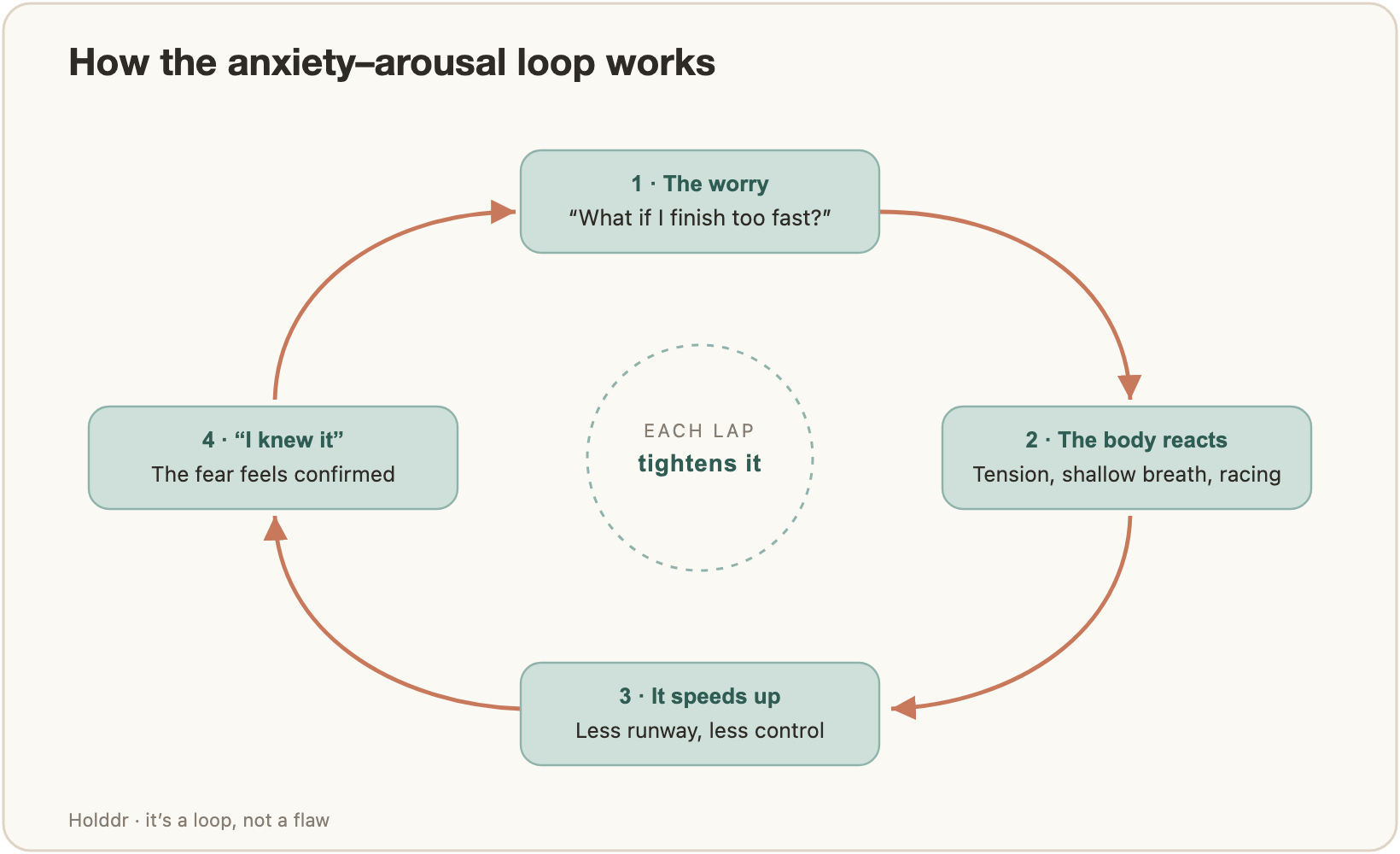
It usually runs in four steps, and each lap makes the next one a little stronger:
- The worry. "What if I finish too fast?" The thought arrives, often before anything has even happened.
- The body reacts. Worry switches on a low-grade alarm: muscles tighten, breathing climbs higher and shallower, the heart picks up.
- It speeds up. That keyed-up state leaves less runway and less sense of control — so things move faster.
- "I knew it." The fast finish seems to confirm the fear, which makes the worry louder next time.
And then it repeats. The cruel part is how self-sealing it is: the worry helps create the very outcome that justifies the worry.
Why your body listens to the worry
When you feel put on the spot, your body shifts into something like alarm mode — faster heart, tighter muscles, higher and shallower breath. That state evolved to help you move quickly in the face of a threat. It is, in other words, tuned for speed — not for slowing down and savoring.
Anxiety also tends to raise your baseline level of arousal and narrow your attention onto whatever you're afraid of. So the exact state you drop into when you're worried about finishing fast is a state that's already primed to finish fast. None of that means anything is medically wrong — it's ordinary human physiology doing its job at an unhelpful moment.
The quiet trap: watching yourself
There's a particular habit that pours fuel on the loop, sometimes called spectatoring — mentally stepping outside the moment to monitor your own performance. How am I doing? Am I getting close? Is this going wrong?
The problem is that you can't be relaxed and under surveillance at the same time. Self-monitoring drags attention away from sensation and connection and toward judgment — and judgment feeds anxiety. Learning to drop back into what you actually feel, rather than narrating it from the outside, is one of the most useful skills there is. (It's the same attention skill behind stop-start practice.)
But it isn't "just anxiety"
Here's where a lot of advice gets it wrong. Anxiety is often part of the loop — but faster timing is not always only about anxiety. Body, context, the relationship, medication, and general health can all play a role too.
So "just relax" is not only unhelpful, it's frequently inaccurate. It's worth resisting the urge to pin everything on a single cause — and worth knowing that calming the nerves, on its own, isn't guaranteed to be the whole answer. There's also no single "right" duration to measure yourself against; what matters more is consistency, the sense of control you feel, and how much it actually bothers you.
How the loop actually loosens
You rarely beat anxiety by attacking it head-on — "stop being anxious" has never worked for anyone. What tends to work is changing the inputs that feed the loop:
- Slow the breath. Long, slow exhales send your alarm system a signal that it's safe to downshift, and they buy a small pause before urgency takes over. Breathing won't flip arousal off like a switch, but it changes the conditions the loop runs in. (More in why breathing matters for sexual confidence.)
- Come back to sensation. Trade self-monitoring for simply noticing what you feel — which also makes it easier to read arousal early, while you still have choices. (See the arousal scale.)
- Lower the stakes. Practice in low-pressure settings so the moment stops feeling like a pass-or-fail test. Pressure is the loop's favorite fuel.
Each calm rep is a small piece of evidence to your nervous system that high arousal doesn't have to tip into panic. Do that enough times and the loop slowly loses its grip.
This is the whole design logic behind Holddr: breathing, arousal awareness, and a short pre-intimacy routine that lower the baseline before things begin — plus a private AI wellness coach for the anxious thoughts you'd rather not say out loud to anyone.
When it's worth talking to someone
A quick professional conversation makes sense if the change is recent (things were fine, then weren't), if there's pain or new erectile or urinary symptoms, or if getting or keeping an erection is also a challenge — that's usually worth addressing first. And if anxiety is heavy and persistent across your life — not just in the bedroom — a therapist can genuinely help.
FAQ
Is premature ejaculation caused by anxiety?
Anxiety is often one part of the loop, but faster timing isn't always only about anxiety — body, context, relationship, medication, and health factors can all contribute. No article (and no app) can diagnose the cause for you; that's a conversation for a clinician if you want certainty.
If I fix my anxiety, will my timing sort itself out?
Not necessarily, and it's worth being honest about that. Lowering anxiety often helps, but because more than one factor can be involved, calming the nerves isn't guaranteed to be the complete answer on its own.
What is spectatoring?
It's the habit of mentally watching and grading your own performance from the outside during intimacy. Because it pulls attention toward judgment and away from sensation, it tends to feed anxiety rather than ease it.
Does this get worse the more I worry?
The loop can reinforce itself, yes — but that street runs both ways. Just as each anxious lap can tighten it, each calm, low-pressure rep can loosen it over time.
Work with the loop, not against it
Holddr is a private men's wellness app for guided practice around control, confidence, breathing, and arousal awareness. Instead of telling you to "just relax," it gives you small, repeatable ways to change the inputs that feed the loop.
Holddr is a wellness app in the Health & Fitness category. This article is educational and is not medical advice, diagnosis, or treatment. If your concerns are recent, painful, distressing, or come with new erectile or urinary symptoms, please speak with a qualified clinician.
Ready to apply the science?
Join early access to be notified when Holddr launches.