Stop-Start Practice: A Behavioral Training Overview
Of all the behavioral techniques used to build ejaculatory control, stop-start practice is arguably the most well-known — and the most frequently misunderstood. It's often treated as a crude way to delay finishing, a kind of physical white-knuckling. In reality, it's something much more useful: it's awareness training.
Control isn't about gritting your teeth and holding on; it's about noticing arousal early enough to make choices about it. Stop-start practice is the laboratory where you build that skill.
What stop-start practice actually is
At its core, stop-start is a solo practice built around a simple rhythm: stimulate, pause, settle, repeat. You bring arousal up to a moderate level, stop all stimulation completely, let the arousal drop back down, and then begin again. You run that cycle a few times before finishing.
The goal is not to see how close you can get to the edge before stopping. The goal is to get very good at reading the middle range of arousal, and very comfortable with the feeling of arousal rising and falling without panic.
Why it works: retraining the alarm
For many men who struggle with fast timing, arousal feels like an alarm bell. The moment it starts climbing, a performance anxiety loop kicks in: the body tightens, breathing goes shallow, and the rush toward the finish line accelerates. The nervous system effectively maps "arousal" as a threat state.
Stop-start practice breaks that mapping. By repeatedly bringing arousal up and letting it settle in a calm, low-stakes environment, you are giving your nervous system new evidence. You're teaching it that climbing arousal doesn't mean you're out of control, and it doesn't mean the end is inevitable. It's just a feeling you can steer.
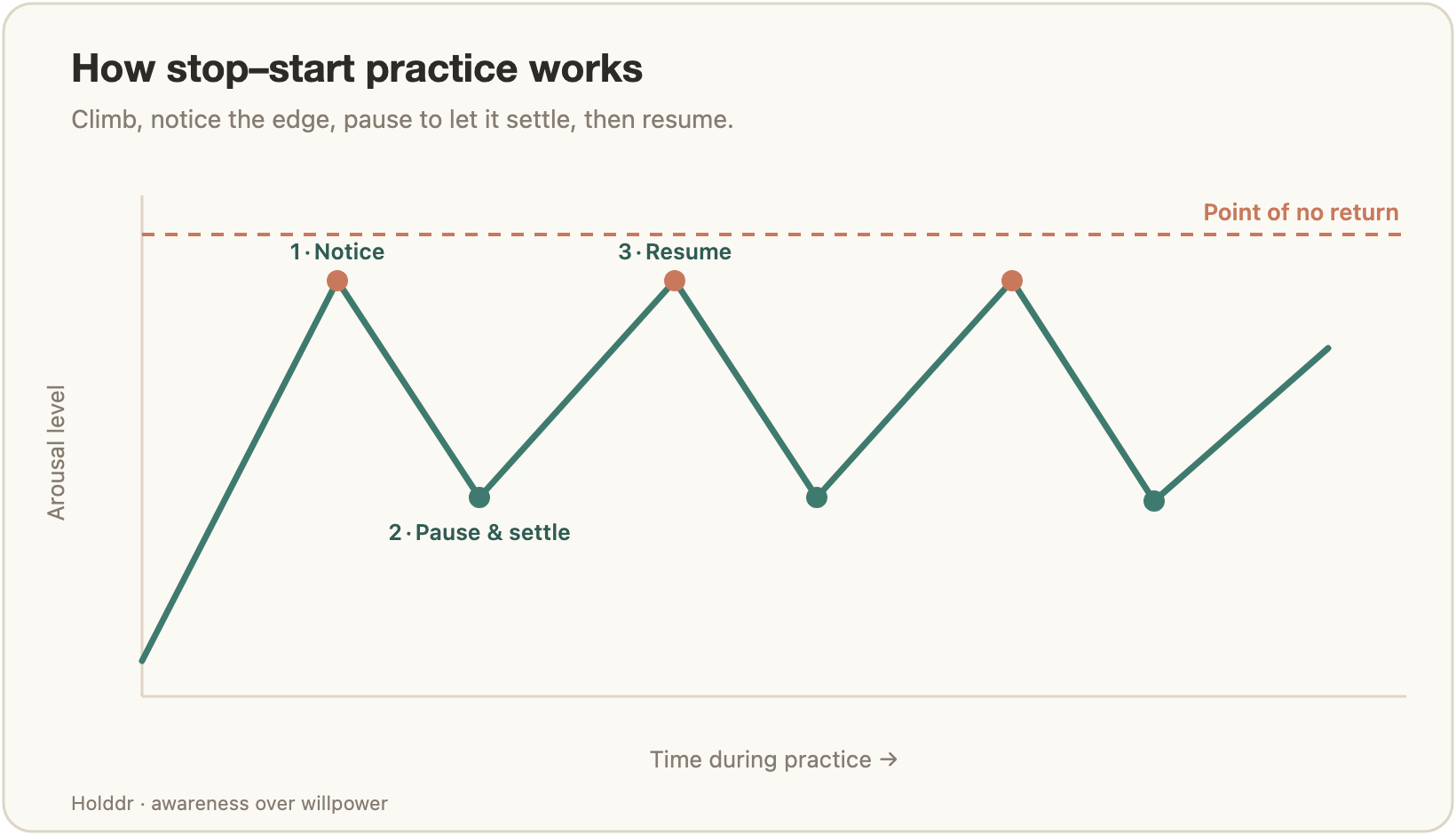
How to practice it: the basic cycle
This is best learned solo, without the pressure or distraction of a partner. Create a quiet environment where you won't be interrupted.
- Begin: Start stimulation at a comfortable, deliberate pace.
- Read the dial: Pay close attention to your body. Where are you on the 1–10 arousal scale?
- The Stop: When you reach roughly a 7 out of 10, stop all stimulation completely. Don't wait until an 8 or 9 — you want to practice stopping before the edge, not right on it.
- The Settle: Take your hands away. Breathe slowly — long, calming exhales. consciously relax your pelvic floor and your jaw. Wait until your arousal drops back down to roughly a 3 or 4.
- Repeat: Begin stimulation again. Run through this full stop-and-settle cycle 3 to 4 times.
- Finish: On the final cycle, you can choose to continue to ejaculation.
The most common mistakes
It's easy to turn this practice into an accidental frustration engine. Here are the traps to avoid:
- Stopping too late: If you wait until a 9, you're practicing emergency braking. The skill lives at a 7 — noticing it early enough to ease off calmly.
- Using distraction: Don't try to think about baseball or spreadsheets during the pause. Distraction pulls you out of your body. You want to feel the arousal, and you want to feel it subsiding. Stay present.
- Holding tension: Don't freeze or tense up during the pause. The "settle" phase is an active release of tension, especially in the pelvic floor. A gentle reverse-kegel "let-go" is perfect here.
- Watching the clock: The timer is irrelevant. Your only job is reading the arousal scale.
What about the "Squeeze" technique?
You might hear stop-start mentioned alongside the "squeeze" technique (squeezing the base of the glans during the pause to forcibly reduce arousal). While both are behavioral methods, many find the squeeze adds unnecessary physical pressure and interrupts the mindful awareness the practice is meant to build. The gentler stop-start approach — pausing and using breath and tension release to settle — is generally preferred as a starting point because it focuses purely on internal control.
From solo practice to partner
Stop-start is a solo skill first. You wouldn't learn to juggle while riding a unicycle; you shouldn't try to learn ejaculatory control while managing the complexity of partnered sex. Master it alone over several weeks.
Once it feels familiar and automatic, the principles transfer. "Stopping" during intimacy might not mean stopping everything; it might mean slowing down, changing position, or shifting the focus entirely to your partner while you settle. The core skill — reading the 7 and deciding to ease off — is exactly the same.
Consistency over speed
Skill-building takes time. Think of it like physical therapy or learning a new language. You are rewiring an ingrained physical response, and that requires repetition. Most clinical approaches recommend practicing 2 to 3 times a week for at least 8 to 12 weeks before expecting significant, durable changes in partnered situations. Consistency is the lever.
FAQ
How often should I practice stop-start?
Aim for 2 to 3 times a week. More isn't necessarily better; consistency over weeks is what creates the change.
When do I stop?
Stop when you reach roughly a 7 on your personal arousal scale — distinctly elevated, but comfortably before the "point of no return."
How long does it take to see results?
Behavioral training usually takes 8 to 12 weeks of consistent practice. The early signs of progress are usually internal: noticing arousal earlier, feeling calmer during the pauses, and recovering faster if you get too close to the edge.
Do I have to do this forever?
Usually not. The goal is for the awareness and the pacing to become an automatic, felt sense during intimacy, rather than a structured drill you have to actively run.
Guided practice makes it simpler
Holddr is a private men's wellness app that takes the guesswork out of behavioral training. It provides paced, guided stop-start sessions, integrates breathing and pelvic floor release directly into the practice, and helps you track your progress over time — so you just have to show up and practice.
Holddr is a wellness app in the Health & Fitness category. This article is educational and is not medical advice, diagnosis, or treatment. If your concerns are recent, painful, distressing, or come with new erectile or urinary symptoms, please speak with a qualified clinician.
Ready to apply the science?
Join early access to be notified when Holddr launches.