What Ejaculatory Control Actually Means
We tend to talk about "control" as though it were a test of willpower — grit your teeth, hold on, think about something boring, try harder. That framing isn't just unhelpful. It's the wrong model entirely, and it's a big part of why so many men feel like they're failing at something.
Here's the more accurate, and frankly more hopeful, way to see it: ejaculatory control is a learned skill. And skills, by definition, can be practiced and improved. This article is about what that skill actually is — and why "just hold on" was never going to work.
The willpower myth
The standard advice is some mix of hold on, distract yourself, and power through. Each one fails for a specific reason:
- Willpower collapses exactly when you need it. Under high arousal and anxiety — the very moment you're trying to use it — willpower is at its weakest.
- Gritting your teeth adds pressure. And pressure is fuel for the anxiety–arousal loop that speeds things up.
- Distraction removes the one thing that helps. Thinking about something else pulls you out of the bodily awareness that real control depends on.
Trying harder, in other words, is pulling the wrong lever.
So what is control, really?
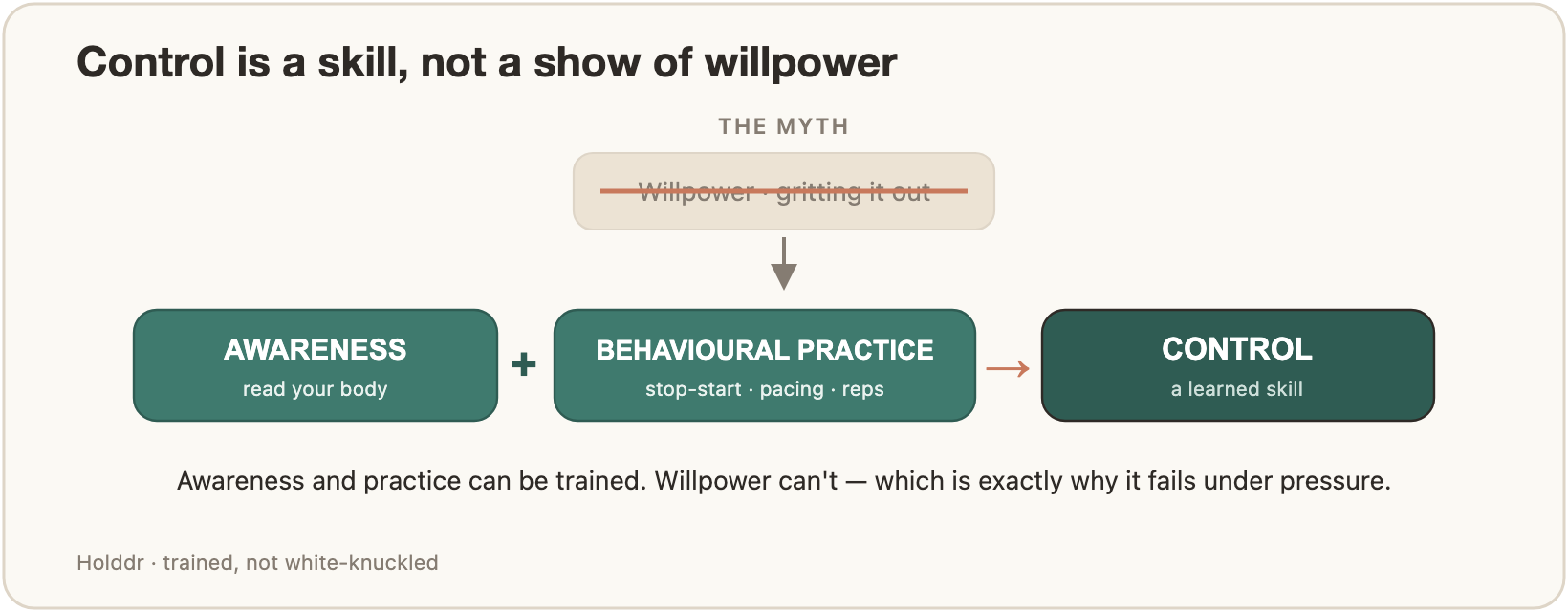
Control is a skill that rests on two pillars:
- Physiological awareness — reading your body in real time: where your arousal sits on the 1–10 scale, where you're holding tension, how you're breathing. You can't steer what you can't feel.
- Behavioral practice — the repetition that trains the response: stop-start, pacing, releasing tension, slowing the breath. Reps, not resolve.
Think of learning to drive. At first, every input is conscious and clumsy — you overthink the clutch, you brake too hard. With practice, it becomes smooth and automatic; you just drive. Control works the same way. It stops being a fight and becomes a felt sense.
Control is broader than the clock
Now the biggest reframe of all: control was never really about lasting longer.
There is no single "right" duration. Timing varies enormously from person to person and from one night to the next, and the occasional fast finish is completely normal. What matters far more than a stopwatch is how consistent it feels, how much control you actually sense, and how much it genuinely bothers you.
"Lasting longer" might be one result of building the skill — but it isn't the definition, and chasing the clock on its own tends to backfire. (After all, that's just willpower with a stopwatch attached.)
What progress actually looks like
Because control is a skill, progress shows up as a whole spread of signals — and minutes are only one of them. Real, meaningful progress includes:
- Noticing arousal earlier
- Feeling calmer, with less panic
- Recovering after a setback instead of spiraling
- A more deliberate, chosen pace
- Communicating more openly with a partner
- Practicing more consistently
- More confidence walking into the moment
Any one of these is genuine progress — and they usually show up first, often well before the clock changes at all.
"So… do I actually have a problem?"
It's the question almost everyone arrives with, and it deserves an honest answer: a stopwatch can't settle it. Clinicians look at timing, perceived control, distress, and context together — and even then, a number on its own is not a diagnosis. Faster timing also isn't always "just anxiety," or any single cause, which is part of why a skill-and-awareness approach makes more sense than a willpower fix.
To be clear: Holddr can't, and won't, tell you whether you "have PE" — that's not its role. If you're distressed about it, or it's a recent change, or there's pain or new erectile symptoms, that's a conversation worth having with a clinician.
The genuinely hopeful part
Here's why "it's a skill" is good news rather than bad: a skill can be learned. You're not stuck with a fixed trait, and you're not failing some test of manhood. You're building an ability — through awareness and practice — exactly the way you'd build any other.
That's the entire premise behind Holddr: structured, paced practice — stop-start, breathing, pelvic floor awareness, arousal awareness — plus a private coach for the questions you'd rather not ask anyone. It turns "control" from something you white-knuckle in the moment into something you've quietly trained for in advance.
When it's worth talking to someone
If the concern is causing real distress, if it's a recent change after things were fine, if there's pain or new erectile or urinary symptoms, or if erections are also a challenge — those are all good reasons to speak with a clinician first. None of it is cause for alarm; it's just the sensible order of things.
FAQ
What is ejaculatory control?
It's a learned skill built on two things: physiological awareness (reading your arousal, tension, and breath) and behavioral practice (like stop-start and pacing). It's broader than "lasting longer," and it's trainable — not a matter of willpower.
Is control just about willpower?
No — and that's exactly why "just hold on" tends to fail. Willpower is weakest under pressure and adds the very tension that speeds things up. Awareness and practice, unlike willpower, can actually be trained.
Do I have premature ejaculation?
An article can't tell you, and neither can a timer alone. It's about timing, perceived control, distress, and context considered together. If it's distressing or a recent change, a clinician is the right person to ask.
How long does it take to build control?
It's skill-building, usually studied over a number of weeks, and there's no guaranteed timeline. Encouragingly, the early signs — earlier awareness, more calm — tend to appear before any change in timing does.
Control you can train, not white-knuckle
Holddr is a private men's wellness app for guided practice around control, confidence, breathing, and arousal awareness. It treats control as the learnable skill it actually is — built through steady, structured practice rather than willpower in the moment.
Holddr is a wellness app in the Health & Fitness category. This article is educational and is not medical advice, diagnosis, or treatment. If your concerns are recent, painful, distressing, or come with new erectile or urinary symptoms, please speak with a qualified clinician.
Ready to apply the science?
Join early access to be notified when Holddr launches.