Why Breathing Matters for Sexual Confidence
Of all the tools for staying calm and confident during intimacy, breathing is the most underrated — and the most misunderstood. It's free, always available, and it's the one lever that touches your nervous system directly, in real time.
But it's worth being honest about what breathing does and doesn't do, because that honesty is exactly what makes it useful. Breathing is not a switch that turns arousal off, and it's not a trick for the clock. What it does is change the conditions you're operating in — and that turns out to matter a great deal.
Your breath is a remote control for your nervous system
When you're anxious, your breathing changes without you deciding it to: it gets faster, shallower, and higher in the chest. That's part of the body's "alarm" setting — the keyed-up state that's tuned for speed, not for slowing down.
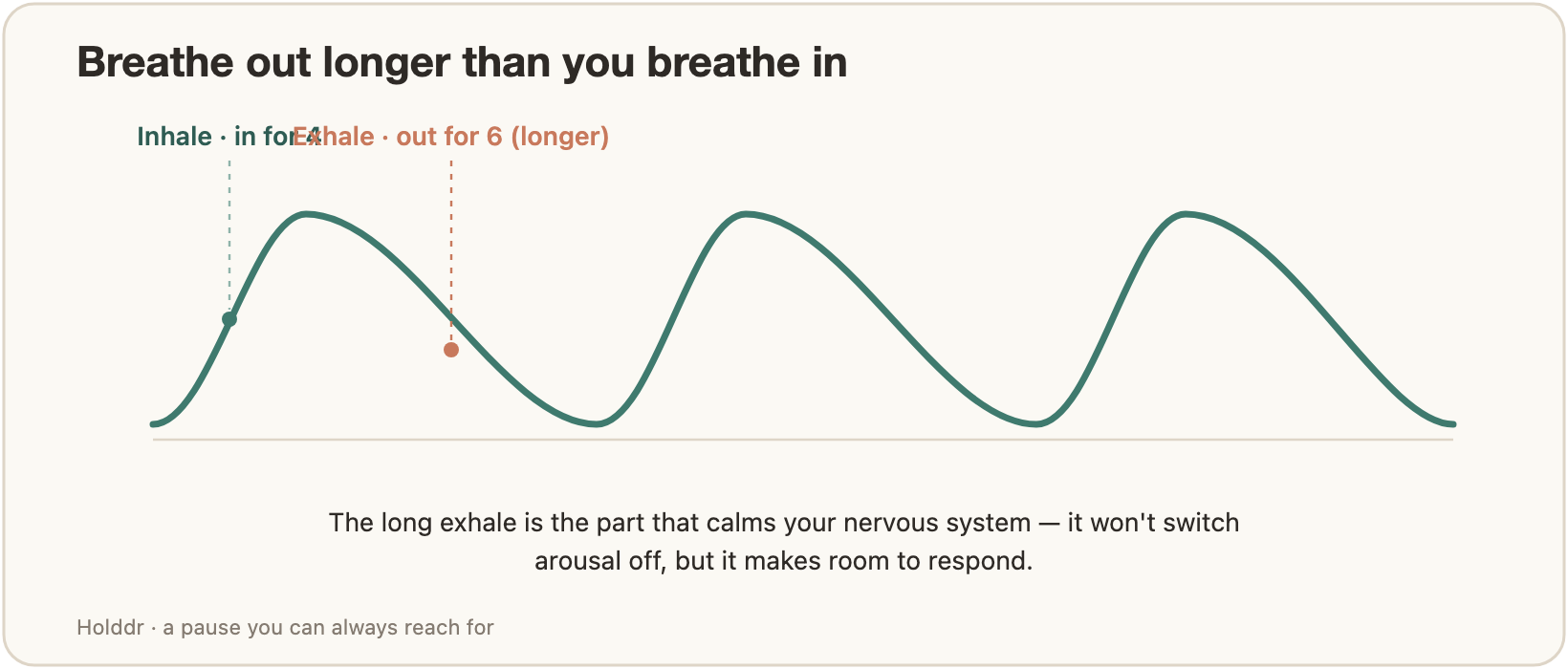
Slow, low, unhurried breathing — especially a long, gentle exhale — nudges you the other way, toward the body's "rest and settle" setting. The exhale is the calming half of the breath; lingering on it is what sends your system the signal that it's safe to downshift.
One honest note on the science: the evidence that slow breathing reduces stress and tension is strong and well-studied. The evidence tying breathing specifically to ejaculation timing is much weaker. So the right way to think about breath is as a confidence and calm tool — not a timing technique in disguise.
What breathing actually does for confidence
Three concrete things, all of which compound:
- It lowers your baseline. A few slow breaths before things begin means you start from a calmer place — the heart of a good pre-intimacy routine.
- It gives you something to do. When you notice arousal climbing toward a 7 on the scale, a slow exhale is a calm action you can take — instead of panicking, which only adds fuel. It buys a beat between stimulus and reaction.
- It anchors your attention. Following the breath pulls you out of the anxious, self-watching headspace (spectatoring) and back into your body and the moment.
Confidence grows out of these quietly. Knowing you have a reliable tool you can reach for — any time, without anyone noticing — changes how the whole experience feels before it even starts.
What breathing does not do
Let's set expectations clearly, because over-promising is how breath gets dismissed as useless:
- It will not instantly switch off arousal.
- It is not a guaranteed delay or a kill-switch.
- It works gently and over repetition, by shifting the conditions — not by overriding your body in the moment.
If a source promises that breathing alone will "make you last," be skeptical. What it reliably offers is calm and room — and that's plenty.
A simple breath to practice
The most useful pattern is extended-exhale breathing:
- Breathe in gently through the nose for about a count of four.
- Breathe out slowly for about a count of six — the exhale longer than the inhale.
- Let it come from low in the belly, not high in the chest. A few unhurried rounds is enough.
Two tips that make the difference: practice it daily when you're calm, so it's automatic when you actually need it — and never force it. Straining the breath defeats the entire point.
Inside Holddr, this breathing is paced for you — gently guided so you're not counting in your head — and woven into both the Pre-Sex Routine and the stop-start practice, so calm becomes part of the technique rather than a separate chore.
When it's worth talking to someone
Breathing practice is safe for almost everyone. Ease off if it ever makes you lightheaded, and if anxiety is heavy and persistent across your life — not just during intimacy — a therapist can help. The usual signposts apply too: recent changes, pain, or new erectile or urinary symptoms are worth a clinician's input.
FAQ
Does breathing help you last longer?
Not directly, and not as a guarantee. What slow breathing reliably does is reduce performance stress, anchor your attention, and create a pause — which gives you more room to respond. Think of it as building confidence and calm, not buying minutes.
What breathing technique is best?
Slow, low breathing with a longer exhale than inhale (for example, in for four, out for six) is a simple, well-supported place to start. Box breathing — equal counts in, hold, out, hold — works well too.
How quickly does it help?
The calming effect can often be felt fairly quickly in the moment. Building it into a dependable habit you can lean on under pressure takes regular practice. There's no promised timeline for changes in timing.
Why do I breathe fast during intimacy when I'm anxious?
That's your body's alarm response doing its job — faster, shallower breathing is part of the keyed-up state. It's completely normal, and slow breathing is how you gently steer back out of it.
Build the one tool you always have on you
Holddr is a private men's wellness app for guided practice around control, confidence, breathing, and arousal awareness. Its guided breathing paces the calm for you and folds it into the moments that matter — so it's there when you reach for it.
Holddr is a wellness app in the Health & Fitness category. This article is educational and is not medical advice, diagnosis, or treatment. If your concerns are recent, painful, distressing, or come with new erectile or urinary symptoms, please speak with a qualified clinician.
Ready to apply the science?
Join early access to be notified when Holddr launches.